Thursday, February 2, 2012

I'm Done! (+ Roller Coaster Tips)

Well this semester has come to an end...I survived all 7 (?) units and even the roller coaster and exam. Didn't do too badly either. I must say I will miss this class...but tomorrow is a whole new semester.

Tips to future students:
Ask questions! Think a little beyond what you hear in the class and ask why...don't accept what they tell you without question. Good luck future semesters!

Concerning the roller coaster, here are our top 10 tips. Please take our word for it: if you keep these things in mind, your life will be SO much easier.
  1. Use gentle back-and-forth motions when bending the I beam (to avoid kinking)
  2. Roll your cylindrical object against the I beam when bending to keep the loops round (seriously, make your loops as round as possible. Pointy = ball no likey)
  3. ***Make one length of I beam, and immediately begin attaching it to your frame. That way you will get a sense of what will work, what you’ll need to do to make the rest of the I beams work and how many I beams you’ll be able to fit in so that you don’t waste money buying and looping more (like we did)***
  4. Get at least part of your major work figured out early, such as your theme, whether you’re focusing on artistic or technical merit, which materials you want to use, where you’re going to build
  5. Check the trash bins of your home hardware store; you might find free useful materials that could come in handy later during building (like us...the store people were amused at how happy we were to get free stuff)
  6. Wear gloves when you are bending the I beam, and use a hammer as a lever to press the I beam into shape when your hands alone don’t have enough strength
  7. Bend loops in opposite directions to save space in your frame
  8. Look at images of previous Wondercoasters for inspiration when you’re stuck on something
  9. Don’t leave decorating to the last minute, because your decorations may alter how your track works
  10. Start as soon as possible when the project is assigned (you’ll regret it if you don’t) (this sounds cheesy but unfortunately it's true)
Also, here are challenges we faced in construction and how we overcame them (there were lots of these):

Bending the I beams

  • We kinked the beam many times because we bent it too fast, wasting a lot of I beam
  • We often bent an angle instead of a round loop
  • These problems meant that the marble’s ride would be bumpy or difficult, which really made attaching to the frame frustrating
How we overcame these challenges
  • Kinking the I beams could be prevented by not bending the beam too fast, or by not unbending the beam after it was bent
  • The kinks could be “cured” somewhat by pressing the protruding sides together using big pliers
  • When bending the I beam into loops, use slow back and forth motions with the beam and roll the cylinder you’re using against the beam
Attaching the I beams to the frame
  • Since the I beams were badly bent in the first place, they caused a lot of trouble when we tried to attach them to the frame
  • They had to be in exactly the right position in order for the marble to complete them
  • Finding this position, and keeping it in place, especially when we weren’t constantly holding it, was extremely difficult
  • Also, the angle and amount of space each length of track took up in order to work was much higher than expected, so we ended up only using half of the lengths of track we made
How we overcame these challenges
  • Patience! And a lot of it
  • Using various materials to make “Band-Aids” to smooth over the bumps in the I beam
  • The glue gun helped significantly in securing the lengths in place once we found that perfect position
  • Creative use of the materials at hand: wire; hooks from the curtain rod; corrugated cardboard; duct, electrical and Scotch tape
Polytubing
  • Finding a way to smoothly attach polytubing track to the I beam track without the marble bouncing off the edges of the I beam
  • Finding a way to smoothly transition polytubing to the cardboard support and turn
  • Making the polytubing lie straight instead of staying in its natural curve
How we overcame challenges
  • Making a smooth transition between tubing and I beam was something that eluded us…we did our best by at first slitting the tubing and sticking it over the edges of the I beam. Later we tried using the glue gun to secure the two pieces of tubing underneath the middle of the I beam
  • We made two “fangs” with the end of each tube, stuck them into the support, and secured them with glue gun glue
  • We pushed the many nails sticking out of the polytubing track through a flat, straight piece of compressed cardboard on either side of the track to keep the polytubing straight

Saturday, January 14, 2012

20 Sound Notes

And by notes, no, I do not mean musical notes, I mean taking notes or points in writing.

Basically the notes are about waves and the speed of sound.
  • A vibrating source moves with simple oscillating motion 
  • A transverse wave is when the direction of wave travel is perpendicular to the motion of the source (for example, light)
  • A longitudinal wave is when the direction of wave travel is parallel to the motion of the source (for example, sound)
  • A cycle is a complete sequence of motion
  • Wavelength, represented by 
    l 
    , is the length in metres of one cycle
  • Period, represented by T, is the time it takes to complete one cycle in seconds
  • Frequency (f): the number of cycles / time, measured in Hertz (Hz)
  • Amplitude: the maximum displacement (height) of the wave from 0
  • The wave equation is v = 
    l 
    f, which is derived from the kinematics formula v =
    D
    d / 
    D
    t
  • Dense areas of sound waves are compressions
  • Less dense areas of sound waves are rarefactions
  • Factors that affect the speed of sound: the producer, the temperature and density of its medium
  • Stiffer materials result in a faster speed of sound
  • vs = 332 m/s + (0.6 m/s 
    ÷
      °C) (T °C)
  • Speeds close to the speed of sounds are measured in Mach numbers
  • < Mach 1 is subsonic
  • > Mach 1 is supersonic
  • Examples of planes/aircraft that have approached and surpassed the speed of sound include Concorde, while Boeing, although fast, is still subsonic
  • The sound barrier is when pressure is built up when something approaches the speed of sound and catches up to its own sound waves, creating a "wall"
  • A plane breaking the sound barrier creates cone-shaped shock waves that hit the Earth's surface, where the sound is heard as a "boom". This is a sonic boom. 

Wednesday, January 4, 2012

Newton and His Problems

Poor Sir Isaac Newton. After he got hit on the head by the infamous gravity-demonstrating apple, he began having problems--four of them to be exact. Since therapists and such had not been invented yet, Newton realized he had to solve his own problems...but he could only do this by making certain assumptions. Even though Isaac Newton has been dead for a long time, his problems still exist (they outlived him) and they still have to be solved, only now by us poor grade 11s. Here is a list of the assumptions Newton had to make and that are necessary to apply to the solutions of these problems.

Problem #1: Equilibrium
Assumptions:

  • Acceleration: since ax = 0 and ay = 0, overall a = 0 (there is no acceleration)
  • Gravity: g = 9.81 m/s^2 
  • Positive Axes: a set of positive axes must be set
Example Problem:
For some unimaginable reason, Marco decides that he wants to slide down a frictionless rope across Niagara Falls. However, halfway through he realizes that the maximum tension the rope can support is 500 N. If the angle between the rope and the horizontal is 15 º, help Marco figure out what his mass must be to safely cross the waterfall (hint: right now Marco is hanging on the rope). 


Solution: 

Given: T1 max = 500 N     g = 9.81 m/s2    θ = 15 º               Required: m = ?
Analysis: ∑ F = ∑ Fx = 0
∑ Fx = Fg – 2Tsin15 º
Fg = 2Tsin15 º
mg = 2Tsin15 º
Substitution: mmax = 2Tsin15 º / g = 2(500)sin15 º / 9.81 = 26.38 kg

Therefore, he must weigh 26.38 kg or under in order to cross safely. 

Problem #2: Inclined Planes
Assumptions (Static or no movement):
  • Acceleration: since ax = 0 and ay = 0, there is no acceleration or a = 0
  • Axes: the x-axis is now parallel to the direction of friction or to the surface, and the y-axis is now parallel to the normal force or perpendicular to the surface
  • Positive X-Axis: the positive x-axis is in the direction of potential motion
  • Coefficient of Friction: µ = tanθ
Example Problem: If Marco has a mass of 37.6 kg and is sitting without moving on an incline with a coefficient of friction of 0.42, what is the force of friction that he experiences?


Solution:


Given: µ = 0.42     m = 37.6 kg           g = 9.81 m/s2         Required: f = ?
Analysis: ∑F = 0    ∑Fx = ∑Fy = 0       X: ∑Fx = 0   Fgx – f = 0    f = Fgx = mgsinθ
                                                            Y: ∑Fy = 0    FN – Fgy = 0 FN = Fgy = mgcosθ
                                                             µ = tanθ
                                                             f = µFN = mgcosθtanθ
Substitution: θ = tan-1 µ = tan-1 (0.42) = 22.78 º
       Either   f = mgsinθ = (37.6)(9.81)sin(22.78º) = 142.83 N
      Or        f = mgcosθtanθ = µmgcosθ = (0.42)(37.6)(9.81)cos(22.78º) = 142.83 N

Therefore, he experiences a frictional force of 142.83 N.  


Assumptions (Kinetic or with movement):
  • Kinetic friction: fk = µk x FN
  • Axes: the x-axis is parallel to the direction of friction or the surface, and the y-axis is parallel to the normal force or perpendicular to the surface
  • Positive X-Axis: the positive x-axis is in the direction of motion
  • Forces: ∑ F = ∑Fx + ∑Fy , ∑Fy = 0 and ∑Fx ≠ 0
Example Problem: Marco wants to feel the wind in his new hair, so he decides to go sliding. The slide is at an angle of 11º and Marco is travelling with a force of 20.5 N despite 54 N of friction. What is the coefficient of friction of the slide?


Solution:


Given: g = 9.81 m/s2   θ = 11º             f = 54 N          F = 20.5 N
Required: µ = ? (m = ?)
Analysis: ∑F = 20.5N    ∑Fx + ∑Fy = 20.5N    ∑Fy = 0        ∑Fx = 20.5 N
              X: ∑Fx = 20.5 N   Fgx – f = 20.5
              Y: ∑Fy = 0          Fgy = FN = mgcosθ         
              f = µFN                µ = f/FN  = f/mgcosθ         
              m = ?    Fgx – f = 20.5     mgsinθ – f = F           mgsinθ = F + f             m = (F + f)/gsinθ
Substitution: m = (F + f)/gsinθ = (20.5 + 54)/(9.81)sin11º = 39.8 kg
                      µ = f/mgcosθ = 54/(39.8)(9.81)cos11º = 0.14

Therefore, the coefficient of friction on the slide was 0.14. 

Problem #3: Pulleys

Assumptions:
  • Air resistance: there is none
  • Friction: there is no friction when using the pulley
  • Multiple Systems: each side of the pulley can be broken into multiple systems
  • Tension: the tension in both systems is equal and opposite
  • Positive Axis: for each system, the positive axis is in the direction of motion or potential motion
  • Acceleration: the acceleration is consistent for both systems
Example Problem: Marco is hanging off one end of a frictionless pulley while Marco’s friend Tony is hanging off the other end. If Tony has twice as much mass as Marco and the tension in the pulley is 78 N, what is Marco’s mass?


Solution: 


Given: m1 = Marco     m2 = Tony      m2 = 2m1           T = 78 N      g = 9.81 m/s2
Required: m1 = ?
Analysis: System 1: ∑ F1 = m1a = T - m1g                        a = (T - m1g)/ m1
              System 2: ∑ F2 = m2a = m2g – T              a = (m2g – T)/ m2
                  a = a
(T - m1g)/m1 = (m2g – T)/m2
(T - m1g)/m1 = (2m1g – T)/2m1
(T - m1g)(2m1) = (2m1g – T)(m1)
2T – 2m1g = 2m1g – T
3T = 4m1g
3T/ (4g) = m1
Substitution: m1 = 3(78) / (4)(9.81) = 5.96 kg

Therefore, Marco has a mass of 5.96 kg. 

Problem #4: Trains

Assumptions:
  • Multiple Systems: each car of the train can be separated into its own system
  • Air Resistance: there is none
  • Positive Axes: the positive axis (generally it is the x-axis that involves motion) is in the direction of motion
  • Acceleration: the acceleration is consistent for all the system. For this reason, the train can be treated as one entity in order to find acceleration

Example Problem: In Marco's train (shown below), what is the amount of force opposing the motion of the middle car (hint: the amount of force in the opposite direction of motion for the middle car).


Solution:


Given: m1 = 20 kg       m2 = 30 kg       m3 = 40 kg       µ = 0.16           FA = 450 N      g = 9.81 m/s2
Required: T1 – m2a = x = ? (a = ? T1 = ?)
Analysis: and Substitution: Total System: ∑FT = mTa           
∑FT = ∑Fx + ∑Fy 
∑Fy = 0 
∑Fx = FA – f  
        = mTa
a = (FA – f)/mT
   = (FA - µFN)/mT
   = (FA - µmTg)/mT
   = [450 – (0.16)(90)(9.81)]/90
   = 3.4304 m/s2
System 1: ∑F1 = m1a    
∑F1 = ∑Fx + ∑Fy    
∑Fy = 0 
∑Fx = FA – T1 – f     
m1a = FA – T1 – f
       = FA – T1 - µFN
       = FA – T1 - µm1g  
T1 = FA - µm1g – m1a
     = 450 – (0.16)(20)(9.81) – (20)(3.4304)
     = 350 N
System 2: ∑F2 = m2a    
∑F2 = ∑Fx + ∑Fy    
∑Fy = 0 
∑Fx = T1 – T2 – f
       = T1 – x
x = T1 – m2a
  = 350 N – (30)(3.4304)
  = 247.088 N

Therefore, 247.088 N is the amount of force pulling the middle car back. 


Thank you for having the patience to look through this long and incredibly time-consuming to make blog!

    Saturday, December 10, 2011

    Cannon Post-Lab Answers

    After our cannon was fired (not very successfully), we have to answer questions about what we did, why we did it, and applications of what we learned.

    It's a giraffe! :)


    1. What were the two baffles in the cannon for? (the original question has quotes around the word cannon...I wonder why...didn't we make a real cannon?)
    The baffles are left inside the cans in order to help with combustion of the fuel ("hydrogen gas"). When there is more air available for the fuel to burn in, it will burn more completely and more energy will be released as heat. With more heat, the ammunition (the pair of Styrofoam cups) will be pushed farther. The baffles help to mix the fuel by bringing it more in contact with air and oxygen, so that it can combust more completely. The baffles also reflect and keep in heat which further helps with complete combustion of the fuel.

    2. What purpose did the shaking of the stack of cans have?
    The shaking of the cannon also helped with the combustion of the fuel. The shaking allows the fuel to mix with the air and oxygen in the air in order for more complete combustion will occur. If the cannon is shaken more, the fuel will mix more with the oxygen and will combust more completely. With more complete combustion, again, we get more energy released as heat and a better explosion.

    3. What kind of energy transformation occurred during the launch?
    This is basically what our lab report is about...well, first let's look at what kind of energy was initially in the cannon before it was lit. The fuel contained chemical potential energy: it was a chemical that contained a lot of stored energy, enough to explode with the help of some heat and oxygen. When the cannon was shaken, our kinetic or mechanical energy was transferred to the cannon as well (our own energy transformation occurred from the chemical energy in food to electrical energy from the brain and finally the response being kinetic energy in our limbs). A lighter containing butane underwent an energy transformation from the chemical potential energy in the butane through friction to light and heat energy, which was then transferred to a candle. This candle transferred mainly the heat energy to the fuel, which caused a reaction between the fuel and the mixed in oxygen that converted its stored chemical energy to heat or thermal energy. This thermal energy heat the gas inside the cannon so that it moved to expand (kinetic energy) which was then transferred to the ammunition. The ammunition with its mechanical energy shot forward, but eventually descended in a parabolic path due to gravity.

    4. What other kinds of liquids could be used instead of ethanol?
    Well, in most of the sources I found the fuel they used was lighter fluid (butane). Other possible fuels could be gasoline or other alcohols...I think probably any combustible liquid, such as hydrocarbons or alcohols, could be used theoretically but some of them might be safer to use than others (some might be too easily combustible or too explosive or violent).

    5. Apply one of Newton's laws that is relevant to this experiment. Explain. 
    In a way, all three are applicable to this experiment...but since it says only to apply one law, I'll apply the third law: for every action, there is an equal and opposite reaction. I remember that Mr. Chung illustrated the third law using a cannon. When he lit the cannon and the pair of cups shot forward, the cannon itself rocked backward a little. This is because the forward force that the cannon applied to the ammunition resulted in a reaction backward force of the ammunition pushing on the cannon. These forces are equal, but the reason that the cannon does not shoot backward the same way that the ammo shoots forward can be explained using Newton's second law. Since F = ma, and according to Newton's third law the two forces are equal, the much smaller mass of the Styrofoam cups accelerates faster than the heavier mass of the cannon. Therefore the ammunition shoots forward at a much higher acceleration than the cannon rocks backward. (F = F so less m x more a = more m x less a).

    Source: http://www.theteachersguide.com/moredemos.html#sodacan

    Wednesday, November 30, 2011

    Pop Can Cannon Designs

    After researching various exploits of boys and what they did in their spare time back in the day, I have compiled a list of possible designs for making a pop can cannon.

    Materials:
    • 5 cans (minimum 3 cans for the cannon part, and 2 for support)
    • Duct tape to hold them together
    • Ethanol for ignition
    • A pair of Styrofoam cups as ammunition
    • Nail and hammer
    Design Notes
    • Many of the people who wrote about their experiences with making pop can cannons back in the day insist that they used tin cans, and one source even says that aluminum cans would lead to an explosion and a "face full of aluminum shrapnel". Other (probably younger) sources use soda pop cans, or steel cans such as the kind that contain vegetables or soup or juice


    • Although one source uses masking tape as an option to hold the cans together, most sources say duct tape or electrical tape
    • All sources use lighter fluid (butane) as the ignition, but we are using (must use) ethanol
    • All the sources leave the bottom on the bottom can, through which a hole is made for getting the ethanol into the cannon. However, some sources cut all the tops and bottoms off the rest of the cans. Others say to leave in half the bottom of the first can and half the top of the third can as well. Still more involve cutting out like triangles from the third can (the one with the entire bottom and the hole) so that one end of the can looks like a star or cross


    Wednesday, November 9, 2011

    Newspaper Tower

    This is our newspaper tower.


    My, Tannya's and Angeline's spirals :]

    The materials we could use were 4 sheets of the Toronto Star and maybe a little more than a meter of tape. And we only had 30 minutes.

    Ours was probably the fastest made (it took like 10 minutes), and we thought 6 feet would be tall enough...we were wrong. :( Ah well.

    Why did we design our newspaper tower this way? 
    We originally wanted to make a triangular prism, but decided that a design such as that of a camera tripod would be better and would conserve more newspaper: a tripod doesn't need base supports to stand up. Part of the reason why our design could stand so well no matter where it was moved was that our base was not rigidly supported, so it could adjust to different parts of the floor. Our design was very simple and required very little tape, so we used the rest for extra height (hence the 20 cm-long tape extension on the top that Mr. Chung later squished).


    So whole and healthy before it got squished...also note the flag with a :D and spiral that Patrick was so proud of. 

    What physics concepts did we apply?
    Mainly we applied concepts that I remember learning from grade 7 science (some of the few things I retained from that class) : that triangles are the strongest of all shapes (if we built supports, they would have been triangular) because any forces applied to a point of atriangle are distributed down its sides, making it really good at withstanding pressure. Another concept that everyone applied was that the base of the tower should be bigger/wider than the top, such as that of a pyramid. Structures with bases like these are more stable because the wider base brings the center of gravity of the structure closer to the ground. This makes it less likely to fall over.

    Monday, November 7, 2011

    My Favourite Skyscrapers

    Hmm...even though this blog is supposed to be about my favourite skyscrapers, I'm not sure I have any...I mean, it's not the same as having a favourite colour or book. Oh well. I'll do my best. 


    The first skyscraper that I liked was the extremely tall Burj Khalifa in Dubai at over 828 metres tall. Incredible. It is the tallest skyscraper in the world, the tallest free-standing structure in the world (recently beating out the CN Tower), has the tallest elevator service and the longest travel distance in an elevator in the world...and many more. The entire building stands on a concrete mat multiple metres thick, and it's spiralling design "confuses" wind: as the building's shape changes, wind cannot get organized around it, so the spiral minimizes the effects of wind. 


    Another one of the tallest skyscrapers that I liked was Taipei 101. It stands 509 m tall, as well as being 5 stories deep, and was built to resemble a pagoda. Taipei 101 contains an 800-ton pendulum to reduce swaying and can withstand severe earthquakes and typhoons. It is flexible enough to handle strong winds but must remain rigid enough to protect the people and structures inside it. Because Taipei 101 is so tall, it contains additional features like 380 "piles" driven straight into the ground, making it very stable. This stability was tested when it was being built in March 2002, when a 6.8 magnitude earthquake hit Taipei and the building itself was not structurally damaged. 

    (This picture has a nice physics reference as well  :] )

    Although the Bahrain World Trade Center in Manama, Bahrain, is not one of the tallest skyscrapers out there, it caught my attention because of its eco-friendliness. The BWTC is the first large-scale skyscraper to incorporate wind power into its structure, with 3 wind turbines attached to bridges in between the two sail shapes of the building. The sail shapes help to funnel wind and increase the efficiency of the turbines, which generate enough to satisfy about 13% of the tower's energy needs. 


    And finishing off with two buildings in Bangkok, Thailand both designed by architect Sumet Jumsai that I like because I think they're cute :]
     Here is the Elephant Building:


    And here is the Robot Building: 


    Well...that's all for today. :]


    Sources: http://www.burjkhalifa.ae, http://benayah.com/wp-content/uploads/2011/05/Burj-Khalifa-Dubai-full-view-a19794057.jpg, http://offtrackplanet.com/featured/the-10-coolest-skyscrapers-around-the-world/, http://upload.wikimedia.org/wikipedia/commons/6/62/E_equals_m_plus_c_square_at_Taipei101.jpg, http://inhabitat.com/bahrain-world-trade-center-has-wind-turbines/, https://blogger.googleusercontent.com/img/b/R29vZ2xl/AVvXsEg_jSpJ959GGoY4NBreqm_hQaUn3Qb7EPRKyX_xvy0n8vxnt6QyRwctazJDQv-Wvn-RadPOVU9g6sYXs2mC0W8npavH6o6z_cNuxrIIH9k0HA034ANT34nK9hfOR8UoDpAOdvVINIlmNw3t/s1600/Bahrain+world+trade+center.jpg, http://www.cnngo.com/explorations/life/20-most-iconic-skyscrapers-343149?page=0,13, http://i.cdn.cnngo.com/sites/default/files/imagecache/inline_image_400x267/2011/09/22/Bangkok-elephant-building-.jpg, http://offtrackplanet.com/wp-content/uploads/2011/02/robo.jpg

    Tuesday, November 1, 2011

    Blogging Projectile Motion Homework

    We had to blog our homework again...this time it was pg. 113 #22, #23, and #30. They're all about throwing/launching/falling things...

    This question was about a bullet being shot horizontally from a gun...I can't really draw guns. Ah well. I realized the answer was wrong because I forgot to square root 4/9.8 ...so the right answer for time is 0.64s, and the right velocity is 207.6 m/s. I decided to blog the picture for this question anyway...the method is correct. 


    I liked this question because it involved tennis :]. Unfortunately I made the same mistake that I did for the previous question: I forgot to to square root 5/9.8. The right answer for distance is 31.7 m. :/


    This question was about a "lovesick lad" throwing a rock at his girlfriend (it contained a love note and she had a baseball glove, but still. Why didn't they just use email?). Yes! I got this question right. I assumed up was the positive direction, so acceleration (gravity) is negative. 


    Thursday, October 20, 2011

    Icarus, the Ornithopter and Upward

    The Ancient Greek legend of Icarus is one of the first examples of humans dabbling with flight, and unfortunately, paying a steep price for it. (Icarus, along with his father Daedalus, built wings from feathers and wax to escape captivity, and succeeded in flying. However, Icarus flew too near the sun, melting the wax that kept the wings together. He then fell to his death, much to the grief of his father :[ ).


    Since Icarus, people have kept trying to experiment with attaching wings to themselves like birds, but unlike Icarus, this does not work in real life. Humans do not have the muscle strength that birds have to make wings successful. 

    Around 400 BC in China, kites were being made as humans continued to experiment with flying. Kites are the predecessors of gliders and balloons made for flight. 

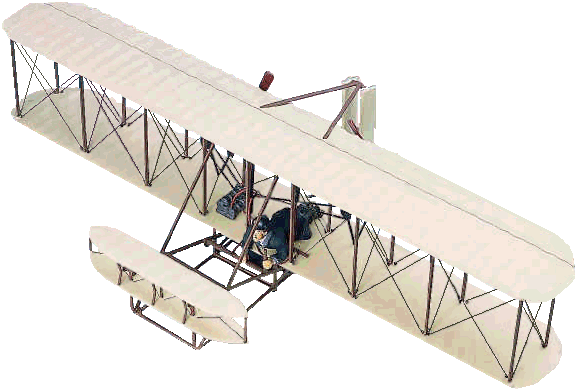
    Then came Leonardo da Vinci with inventions totally ahead of his time, one of which was the Ornithopter. This was one of the first actual flying machines for humans, with two wings and a tail, in the center of which lies the person holding onto handles and stirrups for their feet, with a ring around the torso:


    In 1783, Jacques and Joseph Mongolfier filled a silk bag with hot air so that it floated. Eventually, they attached a basket and the first flight in a hot air balloon was taken by a sheep, a rooster and a duck, at an altitude of 6000 feet for a distance of nearly a mile. :) After that was the first manned flight in a hot air balloon. 


    George Cayley, in the late 1700s to mid 1800s, began a detailed study of gliders that allowed the person flying it to control its movements. He modified the wings so that air flowed over them more effectively, and added a tail for stability. He also realized that for longer flights, a power source would be needed. Cayley concluded that the best type of flying machine for a human would be a "fixed-wing aircraft with a power system for propulsion and a tail to assist in the control of the plane".  


    By the nineteenth and twentieth centuries, more and more scientists were experimenting with flight. The German engineer Otto Lilienthal was fascinated by and studied birds and flight. The Wright brothers based some of their work on Lilienthal's studies. Unfortunately, after more than 2500 flights, Lilienthal was killed when he lost control due to a sudden gust of wind and crashed to his death. 


    Flight among humans further progressed with Samuel Langley and his aerodrome, which included a steam powered engine which he realized was needed if humans wanted to fly for longer distances.


    And finally, here are the Wright brothers. Through a lot of research and background knowledge, Orville and Wilbur Wright first experimented with balloons and kites, then gliders, and then the shapes of wings and such in wind tunnels. Then they began to create an engine that would propel the plane. From all this, they made the Flyer, which on December 17 1903, piloted by Orville Wright, became the first controlled, powered flight that was heavier than air. 


    And from the Wright brothers, humans really went...upward!


    Tuesday, October 18, 2011

    My Unanswered Magnetism Questions--Answered!

    After asking my older sister, (who demonstrated knowledge about high school-level magnetism that even she didn't know she had) I have the answers to my questions!! XD

    Now answered Question 1: What is the difference between magnetic lines of force and magnetic field lines?

    Answer: Actually, there is no difference. The arrows on magnetic field lines represent the direction of magnetic force at that point in the field (the magnetic force is the force that causes something, like an iron filing or a compass needle, to move because of a magnetic field). So, magnetic field lines are lines of force as well.

    Now answered Question 2: What is meant by the magnetic field is "cancelled out"?

    Answer: "Cancelling out" a magnetic field does not mean there is no magnetic field there. It simply means that because the two interacting magnetic forces (the arrows on field lines) are equal but in opposite directions, so the net magnetic force at that point is zero. If a compass needle, for example, was put at a point like this, it would experience equal pull in opposite directions. Therefore, it would not move.

    Now answered Confusing Part about Declination: How can the angle be different at different places?

    Answer: Looking at the picture below and listening to my sister, I realized that while the compass needle will swing towards the magnetic north pole from any point on the Earth, true north is always just straight up. I thought that the angle was between a line drawn to the magnetic north pole and a line drawn to true north, but it's really just between a line drawn to the magnetic north pole and a line drawn straight up. 


    Sources: My sister, and the image, which comes from http://en.wikipedia.org/wiki/Magnetic_declination

    Some Final Questions on Magnetism

    So, because of my test on magnetism tomorrow ( D: ),  I have a list of questions about magnetism that came up as I was going over the concepts again. Here they are in case anyone had these questions/just to help me clarify them to myself.


    Question 1: What is the angle of declination and the angle of inclination?

    Answer: The angle of declination is the angle between true north or geographic north, and magnetic north. Depending on where you are on the Earth, this angle can differ a lot. For example, one not-very-recent statistic states that Eureka, NWT, has an angle of declination of 98 degrees (the magnetic north pole is at 98 degrees to true north there). On the other hand, Churchill, Manitoba, has an angle of declination of 0 degrees, meaning at Churchill magnetic north and true north are in line with each other. To be honest, I'm not too sure how this works.
                 The angle of inclination is the angle between the surface of the Earth and the Earth's magnetic field. At the equator, the magnetic field is parallel to the Earth's surface, but near the poles the magnetosphere :) is at a steep angle to the Earth's surface. Right at the poles, the magnetic field and the Earth's surface are perpendicular to each other. Angle of inclination is measured through a dip needle.


    Question 2: What is domain theory?

    Answer: Domain theory is a theory that explains certain properties of ferromagnets (materials that magnetize extremely well). The theory states that ferromagnets have inside them tiny regions of atoms that are all oriented the same way, so that they have a north and south pole. Generally, these domains are all oriented randomly to each other, so they have a net magnetic effect of zero. However, with a strong enough external magnetic field (such as a coil with current flowing through it), these domains can be aligned to give us one overall north and south pole. If the magnetic field is increased, the domains will become more aligned. There is a point, though, when the domains cannot be aligned any further. Logically, this makes sense.


    Question 3: What does domain theory prove?

    Answer: Domain theory conveniently explains...

    • why ferromagnets can become magnetized after stroking with another magnet (a big example of this would be ships and buildings becoming magnetized during construction as a result of the Earth's magnetic field)
    • why a broken magnet becomes two smaller magnets, not just a north pole and a south pole
    • why a strong magnetic field in the opposite direction can switch the poles of a magnet
    It also explains how magnetic properties can be lost through heating or dropping a magnet: this jostles the orientation of the domains enough that they resume their random orientation.

    For a more in-depth look at domain theory, among other things, go here: Magnets, Magnetism and the Magnetic Field


    I actually had some other questions too...but I don't know all their answers.

    Unanswered question 1: Is there any difference between magnetic lines of force and magnetic field lines?

    Unanswered question 2: If we say that the magnetic fields were cancelled out, does that mean there isn't any field there anymore?

    If I find the answers, I will try to blog them. :)


    Monday, October 17, 2011

    Kinematics and Motion Homework

    Question 45: "If a sprinter accelerates at 2.2 m/s^2 for 2.5 s, what is her velocity after this time, assuming initial velocity is 0?"

    Answer: I chose to substitute the values into Mommy because that equation had all the values I had and needed. I just isolated final velocity and solved for it. Easy.


    Question 47: "A fastball pitcher can throw a baseball at 100 km/h. If the windup and throw take 1.5 s, what is the acceleration of the ball?"

    Answer: It took me a while to come up with this answer, because at first I didn't get that by throw, they meant the ball only moves for 1.5 seconds. After that, using Mommy (her smile gets bigger and bigger, I swear), substituting values, and remembering to convert to m/s wasn't so bad.


    Question 56: "A car travelling at 40 km/h accelerates at 2.3 m/s^2 for 2.7 s. How far has it travelled in that time? What is its final velocity?"

    Answer: At first I got this wrong because I accidentally did the next question, which was the exact same thing but with -2.3m/s^2. Also, it doesn't matter afterward whether you use girl or boy because you have the values for and can find your values through both, but I chose the boy because the girl is used more often in these questions. Give him a chance. 


    Question 58: "If 100m sprinters accelerate from rest for 3.5s at 2.8m/s^2, how far have they run to this point? How long will it take them to complete the 100m sprint, assuming they maintain their speed the rest of the way?"

    Answer: I did the beginning right initially, but made a mistake later because I didn't realize the sprinters had stopped accelerating. Oops. But the answer below is right.


    Question 60: "An object is thrown up from a cliff at 10 m/s and reaches a velocity of 20 m/s down as it lands. If the acceleration due to gravity is 9.8 m/s^2, what is the object's displacement? How long did it take the object to land from the time it was thrown up?"

    Answer: This involves vector adding. Basically we can assume that up is the positive direction and down is the negative direction. Then the velocities are 10 m/s and -20 m/s. Also, Daddy finally comes back into the picture :) !


    The Graff Family

    Well now apparently we have to blog today's homework (which is a lot of work in my opinion: figuring out the questions + what you did wrong + writing them all out nice and big + taking photos + importing them + inserting them + thinking of what to say in this blog...but I'm not complaining ;] ). It's page 71 to 72 in the textbook, #45, 47, 56, 58, and 60.

    Now to the more interesting stuff. Today we learned about the Graff family (it's a real name by the way, as in Steffi Graf, the famous tennis player, but with two F's). Their name rhymes with Graph for a reason, but even so call them the Graff's : they hate being called Graphs. Another name for them is the Big Five.
    Anyway, Mommy (or ze maza) and Daddy (or ze faza) Graff both come from or are derived velocity-time graphs. Maybe I will blog about how some other time. The rest of the family are derived from Mommy and Daddy. This I may also blog at that other time.


    That's ze faza aka Daddy Graff. The block under his eyes are supposed to be a mustache, and the v's are supposed to be vectors. My bad.


    Now Daddy and Mommy are together. Mommy has very curly hair. I also forgot one of her vectors for initial velocity. Careless mistake.


    Next come the twins: a girl and a boy. They're very similar...even their hair is almost the same. He only lacks three of the things she has: another X-chromosome, a bow, and a value for initial velocity.


    Now we have Baby Graff. The baby is a little weird...it actually has no vector signs...sorry...but together they make the whole family !

    Notice that each of the family members (equations) is missing one value. For example, Mommy has no displacement, while Daddy has no acceleration. This means they need to work together to solve your problems.

    *Every d is really supposed to have a delta symbol in front of it, because displacement is a difference. Here it's not written; it's understood to be there.